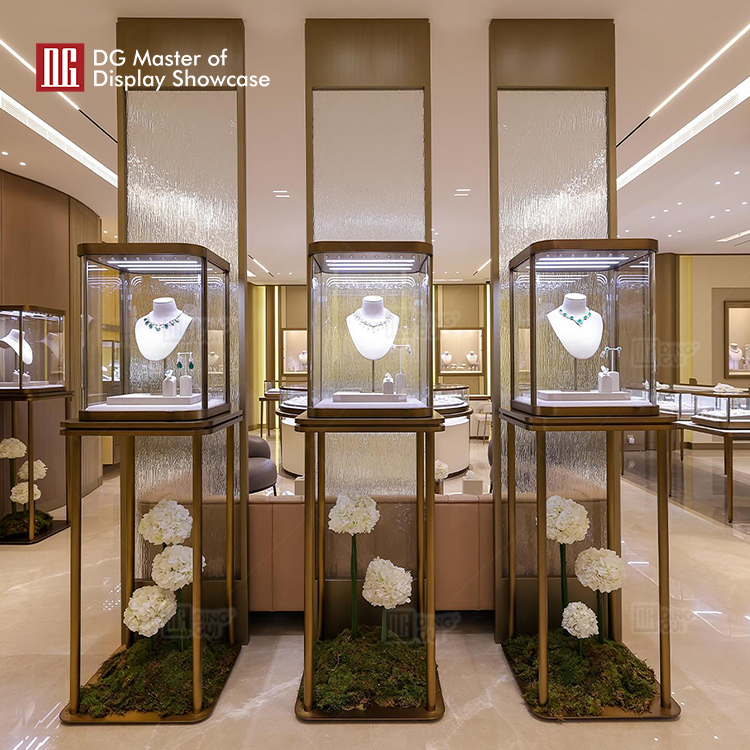
A jewelry showcase is a long-term retail fixture that influences product visibility, store presentation, security, and daily operations. For this reason, quality should be evaluated from several angles rather than based only on appearance or initial price.
When comparing Jewelry Showcase Manufacturers, retailers should examine construction methods, materials, hardware, finishing, customization, and quality-control procedures. A careful evaluation before ordering can help ensure that the finished displays are suitable for the intended retail environment.
Material Quality
The materials used in a showcase have a direct effect on its durability and appearance. Check the specifications for glass, frame materials, panels, shelves, hardware, and interior surfaces.
Ask whether the materials are appropriate for the intended use and whether they can withstand regular cleaning, handling, and customer-facing operation.
Glass Specifications
Glass is a particularly important component because it provides visibility while separating customers from merchandise. Quality assessment should include the type, thickness, processing, and safety characteristics of the glass.
For security-focused displays, ask whether specialized glass options are available. The correct specification depends on the showcase design, panel dimensions, merchandise, and applicable safety requirements.
Structural Strength
A quality showcase should remain stable during normal use. Examine how the frame, base, shelves, and supporting components are constructed and connected.
Ask about load capacity where relevant, especially for displays containing multiple products or heavier decorative elements. Consistent joints and properly fitted components are useful indicators of careful fabrication.
Precision of Construction
Accurate dimensions are essential for doors, drawers, glass panels, shelves, and other moving or fitted components. Even small inconsistencies can affect functionality and appearance.
Manufacturers should have processes for maintaining dimensional accuracy throughout production. Technical drawings and approved specifications can also help ensure that the final product matches the agreed design.
Finish Quality
Surface finishing contributes to both visual appeal and long-term maintenance. Inspect painted, laminated, veneered, metal, and other surfaces for consistency.
Look for even application, clean edges, properly finished corners, and a consistent appearance across different components. If multiple showcases are being ordered, finish consistency is especially important.
Hardware Performance
Hinges, locks, drawer slides, handles, tracks, and brackets are frequently used throughout the life of a showcase. Poor-quality hardware can create operational problems even when the main structure is well made.
Test doors and drawers for smooth movement and check that locks operate reliably. Hardware should also be appropriately sized and fitted for the weight and frequency of use.
Lighting Integration
Lighting quality should be evaluated as part of the overall showcase rather than as a separate feature. Check the positioning, brightness, color temperature, wiring, and accessibility of the lighting system.
Well-integrated lighting should illuminate merchandise effectively without creating excessive glare or interfering with doors, shelves, or other components.
Security Features
Jewelry displays often require a combination of physical protection and controlled access. Examine the construction of locks, doors, glass panels, frames, and storage areas.
Ask manufacturers to explain which security features are included as standard and which can be customized. The appropriate level of security will depend on the merchandise and the retailer’s operating procedures.
Customization Capability
Retail stores vary in size, layout, branding, and merchandising strategy. A manufacturer’s ability to adapt dimensions, finishes, shelving, lighting, and storage can therefore be an important quality factor.
Ask how custom requirements are documented and approved before production. Clear specifications reduce the possibility of discrepancies between the design agreed upon and the finished showcase.
Quality-Control Procedures
A reliable manufacturing process should include inspections at different stages of production. These may cover materials, dimensions, assembly, glass installation, finishing, hardware, lighting, and final appearance.
Ask what checks are performed before shipment and whether the manufacturer can provide quality documentation or inspection information when appropriate.
Sample and Prototype Availability
For custom or large-scale projects, samples can provide useful information about materials and workmanship. A sample finish, hardware component, or prototype showcase can allow retailers to identify potential changes before full production.
This is particularly useful when a project involves multiple display units that need to maintain consistent specifications.
Packaging and Transportation
Even a well-built showcase can be damaged if it is inadequately packaged. Ask how glass, finished surfaces, corners, and delicate hardware are protected during transportation.
For large displays, clarify whether the packaging is designed for the expected shipping and handling conditions. Delivery arrangements should also be considered before the order is finalized.
Warranty and After-Sales Support
Quality evaluation should extend beyond manufacturing. Ask about warranty coverage, replacement parts, repair procedures, and support for issues discovered after delivery.
Components such as locks, hinges, drawer slides, and lighting systems may eventually require replacement or servicing. Knowing how these issues are handled can simplify long-term maintenance.
Brand and Supplier Evaluation
Retailers should consider the manufacturer’s overall ability to meet the project requirements rather than focusing on one specification. Review product information, manufacturing capabilities, communication practices, lead times, and documented experience with comparable display projects.
For example, DG Display Showcase can be assessed using the same objective criteria: construction quality, material specifications, customization, security, finishing, production controls, and support should all be considered before making a purchasing decision.
A Practical Quality Checklist
Before selecting a manufacturer, review these key areas:
- Glass type, thickness, and safety specifications
- Structural materials and construction
- Accuracy of dimensions and assembly
- Surface and edge finishing
- Hardware quality and operation
- Lighting integration
- Security features
- Customization capabilities
- Quality-control procedures
- Packaging and delivery
- Warranty and replacement support
Final Thoughts
Selecting a jewelry showcase manufacturer requires attention to details that may not be obvious from photographs alone. Materials, structural construction, finishing, hardware, lighting, security, and quality-control procedures all contribute to the performance of the finished display.
A thorough evaluation before placing an order allows retailers to compare suppliers using practical criteria and choose specifications that fit their merchandise, store environment, and long-term operational needs.