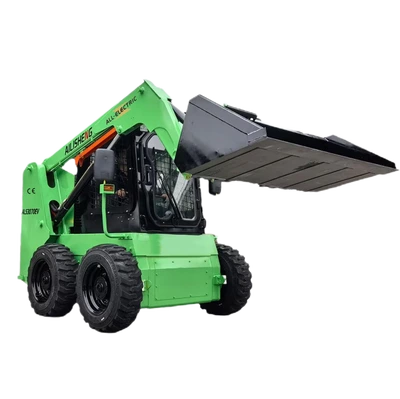
Indoor construction, warehouse operations, and industrial material handling often require equipment that can work efficiently in restricted spaces without creating unnecessary disruption. Narrow aisles, limited access points, noise restrictions, and concerns about exhaust emissions can make conventional heavy machinery less suitable for certain environments. As businesses seek more flexible equipment solutions, battery-powered compact loaders are becoming an attractive option for appropriate indoor applications.
An Electric Skid Loader combines compact maneuverability with battery-powered operation, making it useful for selected material handling, renovation, maintenance, and cleanup tasks. Depending on the model, it can offer reduced operating noise, no tailpipe exhaust during use, and potentially lower routine maintenance requirements. Understanding these advantages helps businesses determine whether an electric skid loader is suitable for their indoor operations.
1. Zero Tailpipe Emissions for Indoor Operations
One of the most significant advantages of an electric skid loader is that it produces no tailpipe exhaust during operation. This can be especially valuable in warehouses, factories, workshops, underground facilities, and enclosed construction areas.
Diesel-powered equipment produces combustion exhaust that requires careful ventilation and exposure management. Battery-powered machinery eliminates this direct source of emissions, potentially making it easier to manage air quality in suitable indoor environments.
However, electric equipment does not eliminate every workplace air-quality concern. Dust, tire particles, hydraulic fluid leaks, and airborne materials may still be present during operation. Proper ventilation, dust control, and workplace safety procedures remain essential.
Before using an electric skid loader indoors, operators should confirm that the machine is approved for the environment and that the facility meets the manufacturer’s operating requirements.
2. Compact Maneuverability in Confined Spaces
Limited working space is a common challenge in warehouses, manufacturing facilities, and indoor construction projects. Large equipment may struggle to pass through narrow entrances or maneuver around stored materials, machinery, and structural obstacles.
Skid loaders are designed for compact operation and tight turns. Their maneuverability allows operators to move materials, clear debris, and perform selected tasks in areas where larger machines may be impractical.
Electric models retain these general design advantages while offering battery-powered operation.
Before selecting a machine, businesses should evaluate:
- Overall width and height.
- Turning clearance and aisle dimensions.
- Entrance and corridor measurements.
- Operating weight and floor load limits.
- Ceiling height and overhead obstacles.
- Access routes for transportation and maintenance.
Matching machine dimensions to the workspace helps reduce unnecessary repositioning and improves operational safety.
3. Reduced Operating Noise
Noise management is important in facilities where construction or material handling takes place near employees, customers, residents, or other ongoing activities.
Electric skid loaders generally produce less engine-related noise than comparable diesel models. This can make them suitable for selected indoor projects where reducing equipment noise is a priority.
Lower operating noise may improve communication between workers and reduce disruption in occupied commercial buildings, warehouses, and industrial facilities. However, the actual noise level depends on hydraulic systems, tires or tracks, attachments, and the task being performed.
Businesses should compare measured noise ratings and assess local noise restrictions before choosing equipment for a specific facility.
4. Efficient Indoor Material Handling
Material handling often involves repetitive tasks such as moving supplies, transporting loose materials, clearing debris, and relocating compatible loads. An electric skid loader can help mechanize these activities and reduce the need for manual handling.
When equipped with suitable attachments, the machine may support tasks such as:
- Moving loose construction materials.
- Transporting compatible palletized loads.
- Clearing debris from designated work areas.
- Moving supplies between storage and work zones.
- Supporting facility maintenance and cleanup.
Productivity depends on rated operating capacity, hydraulic performance, travel distance, and the type of material being handled.
Businesses should organize storage areas and transport routes carefully to reduce unnecessary trips. Clear pathways and designated loading zones can help operators complete tasks more efficiently.
5. Potentially Lower Routine Maintenance Requirements
Electric skid loaders do not require conventional engine oil changes, fuel filter replacements, or diesel exhaust-system servicing. Depending on the design, their electric drivetrains may also contain fewer moving parts than comparable combustion-engine systems.
These differences can simplify some routine maintenance procedures and potentially reduce certain service costs.
Nevertheless, electric loaders still require regular inspection and maintenance. Hydraulic systems, tires or tracks, electrical components, batteries, attachment connections, and safety equipment must be checked according to the manufacturer’s schedule.
Battery health and charging equipment also need appropriate care. Businesses should review warranty coverage, replacement-part availability, and access to qualified technicians before estimating long-term maintenance savings.
6. Flexible Attachments for Different Indoor Tasks
Attachment versatility is another reason electric skid loaders can be useful in indoor material handling and confined spaces. A compatible attachment can allow one machine to perform several different tasks, helping businesses improve equipment utilization.
Common attachment options include:
- Buckets: For moving loose materials and suitable debris.
- Pallet forks: For handling compatible palletized goods within approved load limits.
- Grapples: For collecting certain bulky or irregular materials.
- Sweepers: For cleaning suitable paved surfaces and work areas.
- Specialized attachments: For specific industrial, construction, or maintenance tasks when approved for the machine.
Before choosing an attachment, verify the mounting system, hydraulic flow and pressure, electrical connections where required, and the attachment’s effect on rated capacity and stability.
Some attachments require substantial hydraulic power and can increase energy consumption, so their effect on battery runtime should also be considered.
7. Improved Suitability for Renovation and Building Maintenance
Renovation work often takes place inside existing buildings where access, ventilation, and noise are important considerations. Contractors may need to remove debris, transport supplies, and prepare work areas without causing unnecessary disruption to surrounding activities.
An electric skid loader can support selected tasks when its dimensions, load capacity, and operating characteristics match the project.
The lack of tailpipe exhaust can be beneficial in suitable enclosed environments, while reduced engine-related noise may help limit disruption. Its compact maneuverability can also make it useful in restricted work areas.
However, indoor construction sites require careful evaluation of floor strength, structural conditions, dust exposure, emergency access, and overhead clearance. Electric power does not remove the need for site-specific safety controls.
8. Supporting Productivity in Warehouses and Industrial Facilities
Warehouses and industrial facilities often require regular movement of materials within defined operating areas. Equipment must work efficiently while maintaining safe separation between machinery, workers, stored goods, and other vehicles.
Electric skid loaders may support material movement and designated maintenance tasks where their dimensions and capabilities are appropriate.
Potential operational benefits include reduced engine-related noise, no tailpipe exhaust during use, and flexibility across compatible tasks. These characteristics can be useful in facilities where indoor air quality and employee comfort are important considerations.
Before introducing a loader, managers should assess aisle width, turning areas, floor loading limits, pedestrian routes, and visibility. Clear operating procedures and trained operators are essential for preventing collisions and protecting stored materials.
9. Battery Runtime and Charging Considerations
Battery runtime is a key factor when selecting an electric skid loader for indoor use. The machine must have enough available energy to complete its scheduled tasks without disrupting operations.
Runtime depends on battery capacity, workload intensity, attachment demand, travel distance, temperature, and battery condition.
Charging time varies according to battery size, charger output, battery state of charge, and the manufacturer’s charging limits.
Businesses should evaluate the following factors before purchasing:
- Expected operating hours per shift.
- Typical lifting and travel demands.
- Battery capacity and usable energy.
- Charger compatibility and charging duration.
- Available electrical capacity.
- Opportunities for charging during breaks or overnight.
A planned charging schedule can help reduce interruptions. Facilities should also establish safe charging areas and follow the manufacturer’s requirements for battery storage and charging.
10. Safety Considerations for Confined-Space Operation
Compact equipment can improve access, but operating machinery in confined spaces requires careful planning. Restricted visibility, nearby workers, stored materials, and limited escape routes can create significant risks.
Before using an electric skid loader indoors, operators should verify that the workspace is suitable and that all applicable safety procedures are in place.
Important considerations include:
- Maintaining adequate clearance around the machine.
- Confirming floor strength and load-bearing capacity.
- Keeping pedestrian routes separate where possible.
- Checking overhead obstructions and access points.
- Using compatible attachments within rated limits.
- Following safe load-handling and travel procedures.
- Ensuring operators receive appropriate training.
Battery-powered machinery also requires electrical and charging safety procedures. Damaged batteries or charging equipment should be handled by qualified personnel according to manufacturer guidance.
11. Evaluating the Total Cost of Ownership
An electric skid loader’s value should be assessed through its total cost of ownership rather than its purchase price alone.
Relevant costs include the initial purchase or rental price, electricity consumption, charging equipment, scheduled maintenance, replacement parts, battery warranty, potential battery replacement, and downtime.
Businesses should compare these expenses with those of a suitable conventional loader performing a similar workload.
The financial outcome depends on local electricity prices, utilization, charging efficiency, service availability, and the machine’s expected service life. For facilities that operate equipment regularly in enclosed environments, suitability for indoor work may also be an important operational benefit.
A realistic cost assessment helps determine whether the machine offers practical value for the facility’s specific requirements.
12. How to Choose the Right Electric Skid Loader
Selecting the right model requires matching the equipment to the working environment and daily workload.
Machine dimensions: Confirm that the loader can pass through entrances and maneuver safely in aisles and work areas.
Rated operating capacity: Ensure that the machine can handle expected materials and attachments within approved limits.
Battery performance: Evaluate runtime and charging time under realistic operating conditions.
Hydraulic capability: Verify that the loader supports the required attachments and their energy demands.
Safety features: Review operator protection, visibility, stability guidance, and emergency procedures.
Maintenance support: Check warranty coverage, battery servicing, and replacement-part availability.
Overall operating costs: Include charging infrastructure, energy, servicing, and potential battery replacement.
Where possible, arrange a demonstration under conditions similar to the intended application. A practical assessment can help confirm whether the machine meets the facility’s productivity, access, and safety requirements.
Conclusion
Electric skid loaders offer several potential advantages for indoor material handling and confined-space operations. Their compact maneuverability, lack of tailpipe exhaust, reduced engine-related noise, and attachment versatility can make them suitable for selected warehouses, industrial facilities, renovation projects, and maintenance applications.
Their effectiveness still depends on battery runtime, charging infrastructure, load capacity, attachment compatibility, and site conditions. Businesses should also evaluate floor strength, access restrictions, operator training, and ongoing maintenance requirements before introducing electric equipment into an indoor environment.
By matching the machine to the workload and planning charging and safety procedures carefully, businesses can determine whether an electric skid loader is a practical solution for improving material handling and operational efficiency.