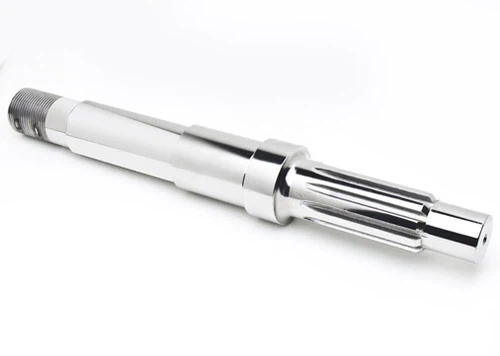
Mechanical assemblies often need a rotating shaft that can also provide a dependable method of retaining a component. A pulley, impeller, fan, wheel, coupling, or small transmission element may need to be secured against movement during operation. Threads provide a familiar and adaptable fastening feature, allowing nuts, washers, and other threaded parts to apply controlled clamping force.
A Motor Threaded Shaft incorporates external threads on all or part of its length so that a mating nut or component can be installed. This arrangement can simplify retention and make disassembly possible during maintenance. Its effectiveness depends on thread geometry, material strength, engagement length, installation torque, and the loads experienced while the motor is running.
How Threaded Shaft Ends Work
An external thread is formed as a helical ridge around the shaft. A matching nut or internally threaded component advances along this profile when rotated. Tightening can create clamping force that holds an attached component against a shoulder, spacer, washer, or other locating surface.
The thread does not necessarily transmit the main operating torque. In many designs, a key, spline, flat, or friction fit carries rotational force while the threaded section provides axial retention. This distinction is important because a thread should not be assumed to perform every mechanical function in the assembly.
Thread Form and Dimensional Specification
Thread selection begins with the required diameter, pitch, thread series, and tolerance class. Metric and inch-based systems are both used in industrial equipment. The chosen thread must match the mating hardware and the design’s dimensional requirements.
Thread length should provide sufficient engagement without creating unnecessary unsupported material. The runout between the threaded and unthreaded sections also deserves attention. A sharp transition can act as a stress concentration, particularly when the shaft is subjected to bending or repeated torque.
Where the assembly uses a nut and washer, the bearing surface should be appropriate for the clamping force. A poorly designed seating face may cause uneven pressure or allow the fastener to loosen.
Material Strength and Thread Durability
Threads reduce the effective cross-sectional area of a shaft and create local stress concentrations at the roots. Material selection must account for these effects as well as the shaft’s operating loads. Carbon steel may be suitable for many general applications, while alloy steel may be required for higher strength or fatigue resistance.
Stainless steel can be considered where corrosion resistance is important, but grade selection should reflect both mechanical and environmental conditions. Surface treatments or coatings may help protect threads from corrosion, provided they do not interfere with fit or assembly.
Thread quality is also significant. Damaged, torn, or poorly formed threads can reduce engagement and make accurate tightening difficult. Manufacturing methods should produce consistent geometry and a suitable surface condition.
Preventing Loosening During Operation
Rotating machinery can expose fasteners to vibration, cyclic loads, and changes in temperature. These conditions may reduce clamping force or cause a nut to loosen. The retention method should therefore be selected according to the risk and operating environment.
Possible approaches include suitable locknuts, prevailing-torque fasteners, locking washers, mechanical locking devices, or thread-locking compounds approved for the application. No single method is appropriate for every assembly. Designers should also specify tightening torque and assembly procedures where clamping force is critical.
Common Industrial Uses
Threaded motor shafts are found in fans, blowers, small pumps, appliances, machine components, and specialized drive assemblies. A fan may use a threaded shaft end to retain its hub, while a compact pump may use threaded hardware to secure a rotating element. In some equipment, a threaded end simplifies removal of a pulley or other accessory during servicing.
The shaft must still be compatible with the motor’s bearing arrangement and permissible external loads. Adding a heavy component or tightening a nut excessively can impose forces that the motor was not designed to support.
Manufacturing and Inspection
Threading may be produced by cutting, rolling, or another suitable process. Thread rolling can improve surface integrity in appropriate materials and production conditions, while cutting offers flexibility for different sizes and designs.
Inspection should verify pitch diameter, major and minor dimensions, pitch, thread condition, and the relationship between the thread and adjoining shaft features. Functional gauges can help confirm compatibility with mating hardware. The finished shaft should also be checked for runout and straightness.
Conclusion
Threaded motor shafts provide a practical means of securing rotating components and supporting serviceable mechanical assemblies. Reliable results require the correct thread specification, sufficient engagement, appropriate material strength, controlled tightening, and a retention strategy suited to vibration and operating loads. When these factors are considered together, threaded connections can remain secure without compromising the motor’s mechanical performance.