Introduction
Tau proteins play an important role in maintaining neuronal structure and supporting intracellular transport. Changes in tau regulation, phosphorylation, and aggregation have been associated with several neurodegenerative conditions, including Alzheimer’s disease. Understanding these changes is an important part of research into disease mechanisms, biomarker development, and neurological health.
Reliable measurement of tau requires analytical methods that can distinguish specific molecular forms and quantify them with appropriate accuracy. Selecting a suitable tau protein assay involves evaluating the target analyte, sample type, detection technology, and analytical performance. Different methods offer distinct advantages, from antibody-based recognition to detailed molecular characterization. Understanding these differences helps research laboratories choose approaches that match their experimental objectives.
Understanding Tau Protein and Its Biological Role
Tau is a microtubule-associated protein found primarily in neurons. It helps stabilize microtubules, which are essential for maintaining cell structure and transporting materials within nerve cells.
Tau function is regulated through several processes, including phosphorylation. Under normal conditions, phosphorylation helps regulate tau’s interaction with microtubules. However, changes in phosphorylation patterns and other molecular modifications have been associated with abnormal tau behavior in neurodegenerative disease research.
In Alzheimer’s disease, tau can become abnormally phosphorylated and aggregate into structures known as neurofibrillary tangles. These changes are associated with neuronal dysfunction and degeneration.
Researchers therefore investigate several forms of tau to understand different aspects of its biology.
Major Tau Biomarker Categories
- Total tau (t-tau): Measures the overall amount of tau detected by an assay, without focusing on a specific phosphorylation site.
- Phosphorylated tau (p-tau): Measures tau modified at particular phosphorylation sites.
- p-tau 181: Detects tau phosphorylated at threonine 181.
- p-tau 217: Detects phosphorylation at threonine 217.
- p-tau 231: Detects phosphorylation at threonine 231.
These measurements provide different information and should not be considered interchangeable. The appropriate target depends on the research question and the analytical method’s validation.
Why Tau Protein Measurement Matters in Research
Tau measurement helps researchers investigate molecular changes associated with neurodegeneration. It can support studies examining protein regulation, disease-related biomarker patterns, and relationships between tau and other biological indicators.
Common research objectives include:
- Investigating tau phosphorylation and aggregation.
- Comparing tau concentrations across experimental groups.
- Studying relationships between tau and amyloid-beta.
- Evaluating potential biomarkers of Alzheimer’s-related changes.
- Monitoring biomarker patterns in longitudinal studies.
- Comparing analytical methods and assay performance.
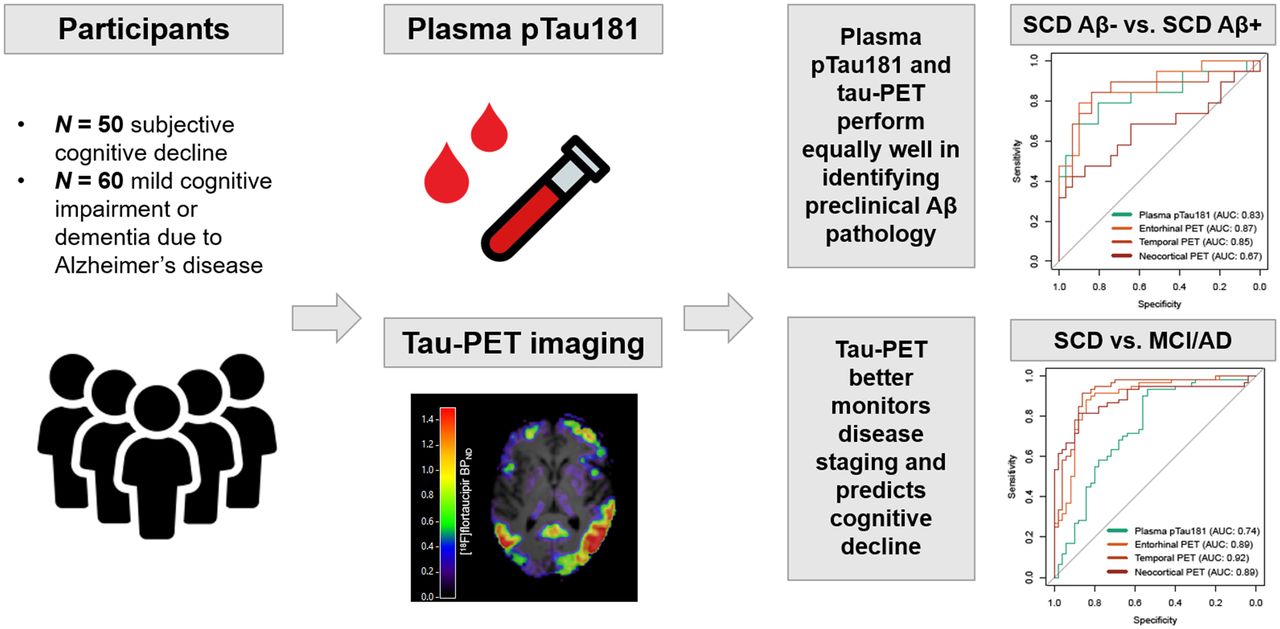
Tau measurements may also be investigated alongside imaging results and other neurological biomarkers to provide a broader understanding of disease-related processes.
Overview of Tau Protein Detection Technologies
Several analytical technologies are used to measure tau proteins. Each method has different principles, equipment requirements, and performance characteristics.
1. Enzyme-Linked Immunosorbent Assay (ELISA)
ELISA is an antibody-based technique widely used in protein research. It detects a target through specific antibody binding and an enzyme-mediated reaction that produces a measurable signal.
In a typical sandwich ELISA, a capture antibody binds tau in the sample, while a second antibody recognizes another region of the target. An enzyme-linked detection system then produces a colorimetric response.
Advantages:
- Established laboratory workflow.
- Broad availability of research assay formats.
- Quantitative measurement when appropriately calibrated.
- Suitability for many protein research applications.
Considerations:
- Incubation and washing steps require careful control.
- Manual handling may introduce variation.
- Sensitivity depends on antibody quality and assay design.
- Performance must be validated for the intended sample matrix.
ELISA can be suitable for laboratories that need a familiar and flexible method for studying tau proteins.
2. Chemiluminescence Immunoassay (CLIA)
Chemiluminescence immunoassay uses antibody-based recognition combined with a light-producing chemical reaction. When the target binds to the assay antibodies, the detection system generates light that can be measured by an appropriate analyzer.
The measured signal is compared with calibration information to estimate tau concentration.
Advantages:
- Potentially sensitive signal detection.
- Compatibility with automated laboratory workflows.
- Standardized reagent handling on suitable platforms.
- Efficient processing of multiple samples, depending on analyzer capacity.
Considerations:
- Assay reagents must be compatible with the analyzer.
- Antibody specificity remains essential.
- Calibration and quality control are required.
- Each intended sample type requires appropriate validation.
CLIA is particularly relevant to laboratories evaluating automated protein measurement workflows. However, the performance of a particular tau assay must be established independently; the general capabilities of an analyzer do not prove that a specific reagent system is validated for use on it.
3. Electrochemiluminescence Immunoassay
Electrochemiluminescence immunoassays use an electrochemically triggered light-producing reaction. The detection signal is generated through a controlled electrochemical process rather than relying solely on a conventional chemical trigger.
This approach can support sensitive protein measurement and multiplex analysis, depending on the platform.
Advantages:
- Sensitive signal detection.
- Potential for multiplex testing.
- Automated workflow options.
- Quantitative measurement using calibration.
Considerations:
- Requires specialized instrumentation.
- Assay reagents must be designed for the platform.
- Performance depends on target-specific validation.
- Results from different platforms may not be directly comparable.
4. Western Blotting
Western blotting separates proteins by electrophoresis before detecting specific targets with antibodies.
The method can provide information about protein size and the presence of particular molecular forms. It is useful when researchers need to investigate protein expression, fragments, or molecular characteristics rather than simply quantify a target in a high-throughput format.
Advantages:
- Provides information about apparent molecular size.
- Supports investigation of protein forms and fragments.
- Useful for studying antibody recognition.
- Can help characterize experimental samples.
Considerations:
- Often involves multiple preparation and processing steps.
- Quantification may be less straightforward than in validated immunoassays.
- Requires careful control of transfer and detection conditions.
- May have lower throughput for large sample sets.
5. Mass Spectrometry
Mass spectrometry measures molecules based on their mass-to-charge characteristics. In tau research, it can help identify specific peptides, phosphorylation sites, and other molecular modifications.
Depending on the method, mass spectrometry can provide detailed information about tau molecular composition that may be difficult to obtain from conventional immunoassays.
Advantages:
- Detailed molecular characterization.
- Ability to investigate specific peptides and modifications.
- Potential to distinguish different tau molecular forms.
- Useful for analytical method development and validation.
Considerations:
- Requires specialized equipment and expertise.
- Sample preparation can be complex.
- Method development and validation may be demanding.
- Instrument and operational costs can be substantial.
Comparing Tau Protein Detection Technologies
The following table summarizes general characteristics of commonly used approaches.
| Technology | Detection principle | Main strengths | Important considerations |
|---|---|---|---|
| ELISA | Enzyme-mediated signal | Established quantitative workflow | Incubation, washing, and manual variability |
| CLIA | Chemically generated light | Sensitive detection and automation options | Reagent-analyzer compatibility |
| Electrochemiluminescence | Electrochemically triggered light | Sensitive measurement and multiplex potential | Specialized platform requirements |
| Western blotting | Protein separation and antibody detection | Molecular-size information | More involved workflow |
| Mass spectrometry | Mass-to-charge analysis | Detailed molecular characterization | Equipment and technical expertise |
No single technology is ideal for every research application. The choice depends on whether the primary objective is routine quantification, molecular characterization, high-throughput analysis, or method comparison.
Key Factors for Selecting a Tau Protein Assay
Selecting an appropriate assay requires evaluating several analytical and practical considerations.
1. Target Specificity
The assay must recognize the intended tau form. Total tau assays and phosphorylated tau assays measure different targets, so laboratories should confirm exactly which molecular form the method detects.
For p-tau assays, antibody recognition of the relevant phosphorylation site is especially important.
2. Analytical Sensitivity
Sensitivity determines the assay’s ability to measure low concentrations of tau. Researchers should review:
- Limit of blank (LoB).
- Limit of detection (LoD).
- Limit of quantification (LoQ).
- Precision at low concentrations.
- Performance across the expected measuring range.
Sensitivity should be evaluated using the sample type intended for the study.
3. Analytical Specificity and Cross-Reactivity
Cross-reactivity occurs when the detection system responds to molecules other than the intended target. Related tau forms and other sample components may affect measurement.
Laboratories should review cross-reactivity and interference studies before adopting a method.
4. Sample Compatibility
Tau can be measured in different biological materials, including cerebrospinal fluid, plasma, and serum. However, assay performance may vary across matrices.
A method validated for cerebrospinal fluid should not automatically be assumed suitable for plasma or serum. Sample-specific validation is necessary.
5. Precision and Reproducibility
Precision describes how closely repeated measurements agree under defined conditions. Reproducibility considers consistency across different runs, operators, or laboratories.
Researchers should review within-run and between-run performance and assess variation across reagent lots where appropriate.
6. Measuring Range and Calibration
The measuring range defines the concentrations over which an assay can provide reliable quantitative results. Calibration establishes the relationship between measured signal and analyte concentration.
A suitable method should provide clear calibration procedures and sufficient performance information to support quantitative interpretation.
The Importance of Sample Preparation
Pre-analytical conditions can influence tau measurement before the analytical reaction begins.
Sample Collection
Collection procedures should be standardized across study participants and sampling time points. Appropriate collection materials and handling procedures can help reduce unwanted variability.
Processing and Storage
Processing delays, centrifugation conditions, storage temperature, and sample stability may affect measured concentrations.
Researchers should follow validated sample-handling procedures and document deviations.
Freeze-Thaw Management
Repeated freeze-thaw cycles may affect protein stability or assay recovery. Preparing suitable aliquots can reduce unnecessary handling and improve consistency.
Matrix Interference
Biological samples contain proteins, lipids, antibodies, and other substances that may interfere with immunoassay reactions. Matrix-specific studies can help identify signal suppression, enhancement, or non-specific binding.
Understanding Calibration and Quantification
Quantitative tau measurement requires a reliable relationship between assay signal and analyte concentration.
In an immunoassay, calibrators with known or assigned concentrations are measured to establish a calibration curve. The signal from an unknown sample is then interpreted using the validated calibration model.
Important calibration considerations include:
- Suitability of calibrator materials.
- Correct preparation and storage.
- Verification of calibration curves.
- Consistency between reagent lots.
- Monitoring calibration stability.
- Use of appropriate quality-control materials.
A signal should not be interpreted as a concentration without reference to the assay’s calibration procedure.
Quality Control in Tau Protein Testing
Quality control helps ensure that an assay continues to perform within established analytical limits.
Laboratories should establish procedures for monitoring control samples, calibration, reagent performance, and instrument operation.
Important quality-control activities include:
- Testing control materials at appropriate concentrations.
- Reviewing control results before accepting analytical runs.
- Monitoring trends and unexpected shifts.
- Recording reagent lot numbers and expiration dates.
- Maintaining instruments according to established procedures.
- Investigating results that fall outside acceptance criteria.
These practices are particularly important for longitudinal research and studies involving multiple experimental batches.
Applications of Tau Protein Assays in Neurodegenerative Disease Research
Tau assays support a wide range of research activities involving Alzheimer’s disease and other neurological conditions.
Alzheimer’s Disease Biomarker Studies
Researchers investigate total tau and phosphorylated tau alongside amyloid-related biomarkers to examine molecular patterns associated with Alzheimer’s disease.
Tau Phosphorylation Research
Site-specific assays help investigate how phosphorylation at different positions relates to tau biology and disease-associated changes.
Longitudinal Biomarker Monitoring
Repeated measurements can help researchers study changes in tau concentrations over time. Consistent analytical methods are essential to distinguish biological trends from technical variation.
Method Comparison and Validation
Laboratories may compare ELISA, CLIA, mass spectrometry, and other techniques to assess differences in sensitivity, specificity, precision, and molecular recognition.
Broader Neurodegeneration Research
Tau measurements may also be studied in other neurological conditions. However, elevated tau measurements are not specific to Alzheimer’s disease and should be interpreted according to the biological context and assay characteristics.
Common Challenges and How to Address Them
| Challenge | Potential effect | Recommended approach |
|---|---|---|
| Antibody cross-reactivity | Inaccurate target measurement | Review specificity data and validate antibody recognition |
| Low analyte concentration | Unreliable quantification | Assess LoD and LoQ |
| Sample degradation | Altered measurements | Standardize collection and storage |
| Matrix interference | Signal suppression or enhancement | Perform matrix-specific studies |
| Calibration variation | Inconsistent concentration estimates | Verify calibration and monitor controls |
| Platform differences | Limited comparability | Conduct method-comparison studies |
| Manual workflow variation | Reduced reproducibility | Standardize procedures or evaluate automation |
Identifying these challenges during method selection and validation can improve research consistency.
Future Directions in Tau Protein Measurement
Tau research continues to evolve as analytical technologies and biomarker strategies improve.
Blood-Based Tau Biomarkers
Blood-based measurements are being investigated as more accessible approaches for studying tau-related changes. Researchers are evaluating plasma and serum assays for analytical performance and their relationships with CSF and imaging findings.
Multiplex Biomarker Platforms
Multiplex systems aim to measure several proteins in one sample or workflow. Combining tau measurements with amyloid-related and neurodegeneration biomarkers may help researchers investigate interconnected biological processes.
Improved Analytical Sensitivity
Advances in antibody design, signal chemistry, and detection systems may improve the ability to quantify low concentrations of tau. Any improvement must be confirmed through rigorous analytical validation.
Integration with Imaging and Clinical Data
Combining tau measurements with brain imaging, cognitive assessments, and longitudinal observations may provide a more comprehensive research perspective.
Conclusion
Tau protein assays are essential tools for investigating molecular changes associated with neurodegenerative diseases. ELISA, chemiluminescence immunoassays, electrochemiluminescence, Western blotting, and mass spectrometry each offer different analytical capabilities.
Selecting the right method requires careful evaluation of target specificity, sensitivity, sample compatibility, precision, calibration, and laboratory workflow. Consistent sample handling and quality-control procedures are equally important for producing reliable measurements.
By matching detection technology to the research objective and validating the complete analytical method, laboratories can generate more reproducible data and strengthen investigations into tau biology, Alzheimer’s disease, and other neurodegenerative conditions.